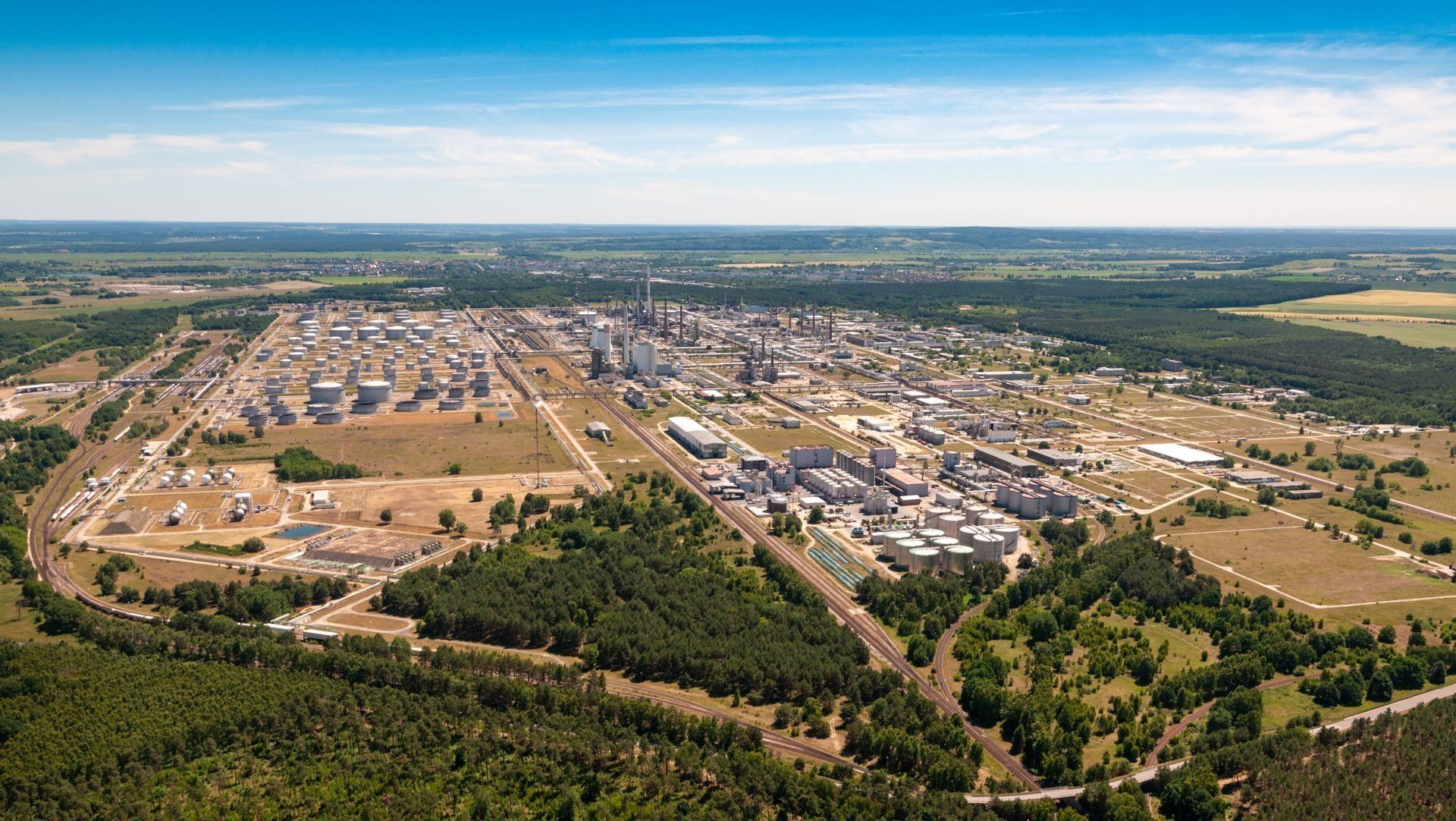
The PCK refinery in Schwedt, one of the largest refineries in Germany, has once again found itself at the center of a political and economic game between Berlin, Moscow and Warsaw. The background of the matter was discussed by Aleksandra Fedorska, editor-in-chief of Radio Debata, who pointed out that the situation is of enormous significance not only for Germany, but also for Poland and the entire region.
As Fedorska explained, the PCK refinery is responsible for fuel supplies for Berlin, north-eastern Germany, and partly also for western Poland. The plant produces aviation fuel as well as asphalt and fuels for transport.
“It is a fairly large refinery, the fifth largest in Germany,” she emphasized.
The problem, however, is that the majority shareholder of the plant remains Russia's Rosneft, which holds around 54 percent of the shares. Although the German government has placed the refinery under trusteeship and frozen the possibility of transferring funds to Russia, the plant formally remains Russian.
Fedorska pointed out that the situation became more complicated after Russia's decision to limit oil deliveries to the refinery.
“Russia acted very unwisely, because it will no longer allow oil to be transported to this refinery through its network,” she said.
Until now, part of the raw material still arrived via Russian infrastructure. After the supplies were restricted, the refinery began to look for alternative sources of provision and turned toward Poland.
In Aleksandra Fedorska's view, Poland is currently in a very favorable negotiating position. Of key importance here are both the “Druzhba” pipeline running through Poland and the infrastructure of Naftoport in Gdańsk.
“The Druzhba pipeline runs through our territory from the east toward Western Europe. Since it is our territory and PERN manages it, we hold good cards,” she emphasized.
An additional advantage is the possibility of importing oil by sea to Gdańsk and then transmitting it further via pipelines.
“From the western direction, the transmission capacity is already practically used up. If Germany had to bring in oil by tanker trucks, the costs would be gigantic,” she noted.
Fedorska also revealed that an idea has emerged in Germany to solve the problem by using an intermediary.
“The Germans will want to persuade the Poles to pull off such a scam, such a lie, that the oil will be bought by Britain's Shell and then sold to Rosneft,” she said.
According to her, all participants in the operation would be aware of the real purpose of the entire transaction, but formally it would not be presented as cooperation with Russia.
Fedorska drew attention to the fact that German society and part of the political elite still perceive Russia as a natural energy partner.
“The Germans choose the eastern direction and Russia, not America. They are afraid of dependence on the USA,” she assessed.
In her view, the conviction prevails in Berlin that, after the end of the war, economic relations with Moscow should return to the earlier model.
“They would prefer to go back to supplies from Russia. The war would have to end so that it would be possible to return to business as usual,” she emphasized.
The conversation also touched on the topic of military cooperation between Poland and Germany. Fedorska spoke about a planned agreement concerning the transfer of troops through Polish territory, as well as German plans to be involved in border protection measures near the Kaliningrad oblast.
“The talk is of around 70 German sappers who are to take part in building our border protection works,” she pointed out.
The journalist emphasized, however, that in her view the presence of the German military at strategic border protection works raises serious doubts.
“Germans should not be present at such works. German-Russian relations are historically very specific,” she assessed.