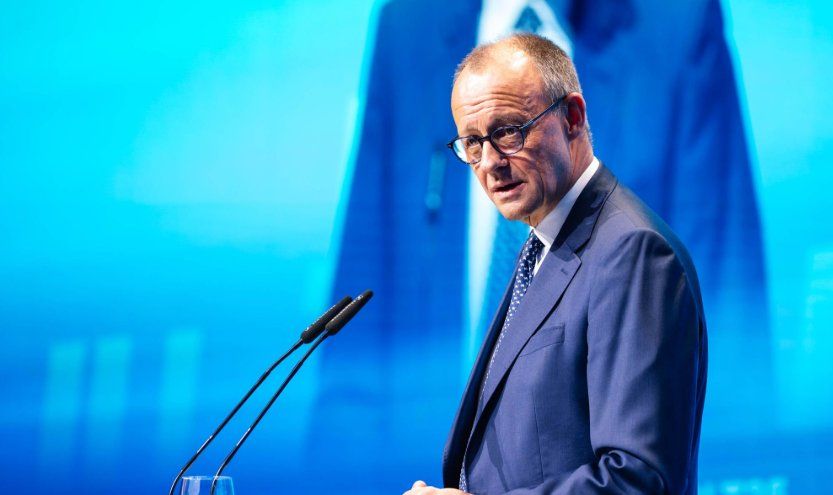
The German political scene is going through a phase of deep destabilisation, whose symbolic turning point was Chancellor Friedrich Merz's recent appearance at a trade-union congress. This incident, characterised by a vehement reaction from the hall – from whistles to openly expressed amusement at the government's proposals – signals a fundamental rupture in the relations between the power elites and the social base. German political culture, traditionally based on restraint and respect for institutions, seems to be losing its hitherto framework, which translates into record-low support for the current head of government, hovering around the level of fifteen percent. The scale of social disillusionment is unprecedented, and the pace of the loss of trust is interpreted as the exhaustion of the previous model of governing the state, based on a compromise between the Christian Democrats and the Social Democrats.
A deeper analysis of the causes of the current state of affairs leads back to the sixteen-year rule of Angela Merkel, whose style of exercising power had a lasting impact on the condition of the German political class. Although the former chancellor enjoyed enormous authority, her strategy of eliminating internal competition and promoting loyal, charisma-deprived executors led to the emergence of a systemic vacuum. In her shadow, leaders capable of bearing responsibility in times of crisis failed to grow, which results in today's presence at the summits of power of politicians described as "failures" or "plastic" figures, devoid of the ability to communicate effectively with the citizen. This structural lack of a leadership reserve means that successive government constellations end in decision-making paralysis and internal conflicts of a financial and ideological nature.
The current situation forces German society and the elites to confront the sharp rise in the significance of the Alternative for Germany (AfD), which in the polls is overtaking the traditional mainstream parties. The strategy of isolating this grouping by means of the so-called cordon sanitaire appears to be losing effectiveness, especially in the face of the upcoming elections in the eastern states, where the AfD is gaining the status of a dominant political force. At the same time, traditional groupings, such as the CDU, are grappling with the absence of a coherent programmatic and personnel alternative. In political backrooms, a return of figures of international stature, such as Ursula von der Leyen, or the promotion of young activists with a historical background, such as Johannes Volkmann, is increasingly being considered, which would be an attempt to regain the party's discipline and credibility.
On the international plane, Germany under Merz's leadership appears as a partner losing significance, which is particularly evident in relations with Donald Trump's administration and within the European Union. A lack of understanding of the new global dynamics and attempts to shift the responsibility for internal mistakes onto external factors deepen the impression of Berlin's helplessness. Foreign partners, such as France under the weakened Emmanuel Macron or the United Kingdom after Labour's electoral defeats, also do not constitute a stable foothold, which leads to Germany's isolation on the diplomatic stage. In this constellation, the German economic model is becoming a source of tensions that the current government is unable to defuse. The German political system finds itself in a state of deep structural crisis. The rejection of the government's proposals by the trade unions and the progressing radicalisation point to the need for a fundamental reconstruction of the political scene. Without leaders capable of breaking the patterns of the Merkel era, Germany may enter a period of prolonged instability, which will also affect relations with its neighbours, such as Poland.