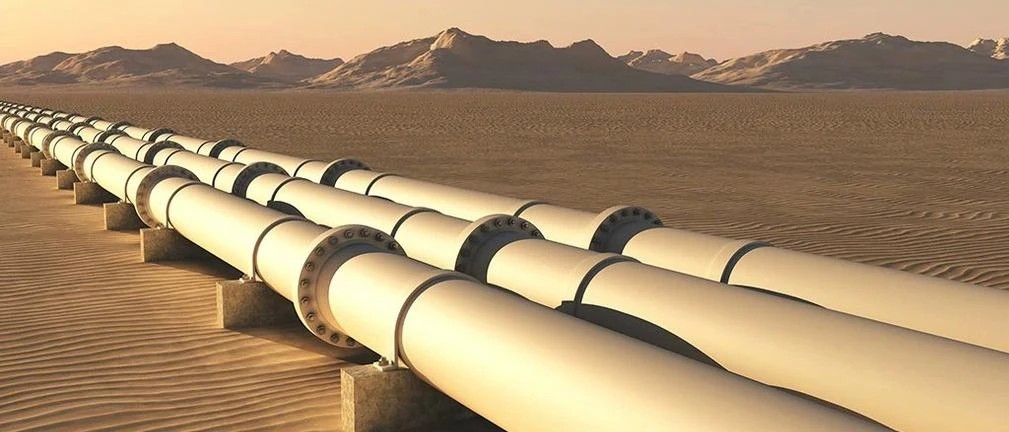
The Trans-Saharan Gas Pipeline (TSGP), a project that has resurfaced time and again over the decades, is entering a new phase. After years of analyses, feasibility studies, and hollow political declarations, early 2026 brought a commitment to actually begin construction.
The initiative, which envisions transporting natural gas from Nigeria through Niger to Algeria and onward to Europe — primarily Italy — has begun to be viewed not merely as a strategic concept but as an infrastructure project with a realistic timeline.
The key impetus has come from Algeria's leadership. President Abdelmadjid Tebboune announced that practical work on TSGP would commence immediately after the month of Ramadan, which in practice means construction starting at the turn of March and April 2026. This declaration was received as a shift from rhetoric to the operational stage.
The project's restart coincided with an improvement in Algerian-Nigerien relations after a prolonged period of diplomatic tensions. The normalization of ties created conditions for resuming infrastructure cooperation, including energy projects of supraregional significance. Diplomatic communiques from both sides referenced a "new dynamic of partnership" in which TSGP occupies a central place.
TSGP remains one of the most ambitious gas projects in the world. Its length is approximately 4,100–4,200 km, its capacity 30 billion cubic meters per year, its estimated CAPEX around $13 billion, and its route runs from Nigeria through Niger to Algeria.
Natural gas from Nigeria — a country possessing some of the largest reserves in Africa — would be transported to Algeria, where it would be integrated into the existing export system. A critical element of the project's economics is the possibility of leveraging Algeria's already functioning connections to Europe. The most frequently cited transmission channel is the Trans-Mediterranean Pipeline (TransMed), linking Algeria and Tunisia with Italy. Alternatively, part of the volume could be directed to Algeria's LNG terminals.
The project rests on the cooperation of three states and their national energy companies: Sonatrach (Algeria), NNPC (Nigeria), and SONIDEP (Niger). Algeria serves as the key export hub, Nigeria as the raw material supplier, and Niger as the transit state. The financing structure is intended to be consortium-based, with potential participation of international capital.
In the wake of the war in Ukraine, Europe continues its strategy of diversifying gas supplies. Although LNG has become the dominant tool of flexibility, pipeline projects still matter in building stable, long-term supply relationships, and Algeria is leveraging the situation to strengthen its position as a key gas supplier to the EU.
TSGP will help increase export volumes and the country's importance in the southern gas corridor. Nigeria, too, stands to benefit as it seeks new export routes, diversifying away from its current concentration on LNG.
In recent years, feasibility studies and legal frameworks have been updated, which has helped reduce some of the formal barriers and key risks. Chief among these is route security, as the Sahel region remains an area of elevated risk. Infrastructure protection costs will significantly affect the project's OPEX. On the other hand, they provide a convincing pretext for a European military presence in that part of the world.
Added to this are the possibilities of coups in Niger, changes of government, regional tensions, and general institutional instability. All of this will inevitably affect the timeline, financing, and costs, while large-scale gas projects are already encountering growing constraints arising from climate policies and ESG criteria.
If construction does indeed begin as announced, TSGP will become one of the most important infrastructure projects connecting Africa with Europe. A potential 30 billion cubic meters per year will not revolutionize the EU market, but it could strengthen diversification, significantly increase the stability of the southern supply corridor, and exert a stabilizing effect on prices in the Mediterranean region.
The year 2026 may prove to be a turning point for the Trans-Saharan Gas Pipeline. Official announcements of work beginning after Ramadan point to a transition into the implementation phase, though the experience of recent decades counsels caution. For now, TSGP remains a project with high strategic potential and an equally high risk profile. Its development will be an important indicator of whether, in an era of energy transition and geopolitical uncertainty, mega pipeline projects can still count on lasting political and financial support. On the other hand, it is a litmus test for Europe's re-entry into the contest for Africa.
Originally published as a featured expert commentary on CIRE.pl.